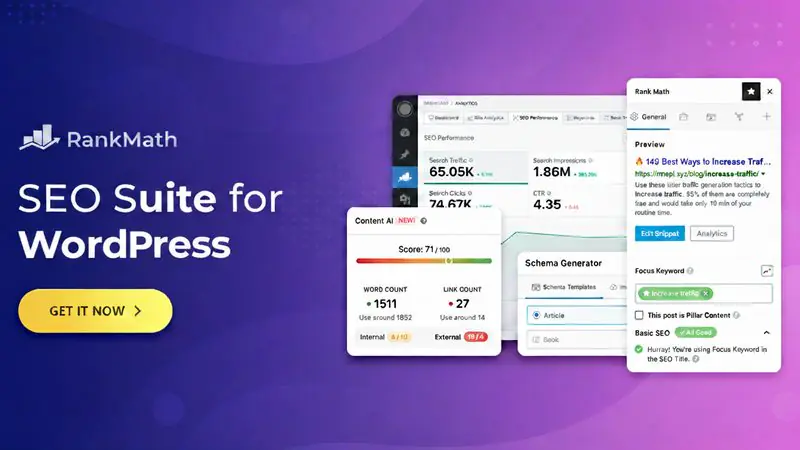
Rank Math and Yoast SEO are the two giants of WordPress SEO in 2026. Yoast SEO pioneered the category — its traffic-light content analysis taught millions of site owners the basics of on-page optimization. But in recent years, Rank Math has won over millions of users with aggressive pricing and a staggering list of built-in features that Yoast locks behind premium add-ons.
Which SEO plugin deserves a place on your site? This honest 2026 comparison breaks down features, ease of use, content analysis, performance, and pricing.
At a Glance: Rank Math vs Yoast SEO
| Rank Math | Yoast SEO | |
|---|---|---|
| Free version | Very generous | Solid basics |
| Focus keywords (free) | Unlimited | 1 per post |
| Schema markup | 20+ types built in | Basic |
| Redirect manager | Built in | Premium only |
| 404 monitor | Built in | Premium only |
| Internal link suggestions | Yes | Premium only |
| WooCommerce SEO | Built in | Separate paid add-on |
| Local SEO | Built in | Separate paid add-on |
| Pro price | $59/year | $99/year |
Features: Rank Math Packs More In
The feature gap is the heart of this comparison. Rank Math's free version includes a redirection manager, 404 monitor, rich schema support with 20+ types, internal link suggestions, and image SEO automation — features Yoast reserves for Premium or sells as separate add-ons.
To match Rank Math's free feature set with Yoast, you would need Yoast SEO Premium ($99/year) plus the WooCommerce SEO, Local SEO, and News SEO add-ons at $69/year each — easily more than $300/year for a single site. Rank Math Pro, at $59/year, covers unlimited personal sites and adds rank tracking, Content AI credits, and advanced analytics on top.
Winner: Rank Math — by a wide margin.
Ease of Use
Yoast SEO is simpler for absolute beginners. Its famous traffic-light system (red, orange, green) gives instant, glanceable feedback, and the interface is deliberately minimal — you are never overwhelmed with options.
Rank Math is more powerful but not harder to start. Its setup wizard configures everything step by step, a one-click importer brings over all your Yoast settings, and the modular dashboard lets you disable features you do not need. There are more options to explore, but the learning curve is gentle and the documentation is excellent.
Winner: Yoast for absolute beginners; Rank Math for everyone else.
Content Analysis
Yoast built its reputation on readability analysis — sentence length, passive voice, transition words, and paragraph structure. It is genuinely helpful for writers who want clean, readable copy.
Rank Math checks more ranking factors: keyword in title, URL, and meta description, content length, image alt attributes, internal and external links, schema presence, and dozens more — plus Content AI suggestions that help you optimize for related keywords and questions.
Winner: Rank Math for the more comprehensive, SEO-focused checklist.
Performance
SEO plugins run on every page load, so bloat matters. Rank Math is modular — turn off the modules you do not use and it stays lean, with efficient database queries and minimal frontend output.
Yoast's core plugin is reasonably light, but once you stack Premium plus several add-ons, the footprint grows noticeably.
Winner: Rank Math — lighter, especially on fully-equipped sites.
Pricing
Rank Math Pro costs $59/year and covers unlimited personal sites — remarkable value. Higher tiers add client-site licenses and more Content AI credits.
Yoast SEO Premium costs $99/year for a single site, and each add-on (WooCommerce, Local, News, Video) costs another $69/year. A fully-equipped Yoast setup for one site can exceed $300/year — every year.
Winner: Rank Math — dramatically cheaper for what you get.
Migration: Switching Is Easy
Already using Yoast? Switching to Rank Math is painless: its one-click importer transfers all titles, meta descriptions, redirections, and settings in under five minutes, with no SEO data lost.
Going the other direction (Rank Math → Yoast) is more manual, since Yoast has no equivalent importer for Rank Math's extra data. This asymmetry is one reason so many users feel comfortable trying Rank Math risk-free.
Which Should You Choose?
- Choose Rank Math if you want the most features at the lowest price, need WooCommerce, Local, or News SEO without buying add-ons, care about performance, want AI-assisted optimization, or are migrating from Yoast.
- Choose Yoast SEO if you are an absolute beginner who values the simplest possible interface, trust the long-established brand, or your team already knows the Yoast workflow inside out.
Bottom line: For most WordPress sites in 2026, Rank Math wins — more features, a lower price, and a lighter footprint. Yoast remains a fine choice for simplicity-first users, but it is hard to justify the cost gap.
Is Rank Math better than Yoast?
For most users, yes — Rank Math’s free version includes more features than Yoast Premium, at a much lower price. Yoast remains simpler for absolute beginners who want a minimal, guided experience.
Can I switch from Yoast to Rank Math easily?
Yes. Rank Math includes a one-click importer that transfers your titles, meta descriptions, redirections, and settings from Yoast in under five minutes, with no SEO data lost.
Is Rank Math really free?
Yes, the core plugin is free and remarkably generous. Rank Math Pro ($59/year) adds rank tracking, Content AI credits, advanced analytics, and support for unlimited personal sites.
Does Yoast slow down WordPress?
Yoast is heavier than Rank Math, especially once you add Premium and several add-ons. For most sites the difference is small, but performance-conscious users generally prefer Rank Math’s modular, lightweight approach.
Which SEO plugin do experts recommend in 2026?
The trend favors Rank Math in Reddit threads and SEO communities, where users praise its features and pricing. Yoast keeps a loyal following among simplicity-first users and agencies with established workflows.